June 13, 2023

Reg A+ Direct to Nasdaq: A New Path to the Public Markets

A Reg A+ direct-to-Nasdaq listing is when a company raises capital through a Regulation A+ offering, then uses that raise and the shareholder base it builds to qualify for a Nasdaq listing, without first filing a traditional S-1 IPO. It lets founders build a community of investors, part of a larger shift of retail capital into private and pre-IPO deals, test demand publicly, and set their own deal terms before reaching the public markets.

On May 18, 2023, Monogram Orthopaedics—a medtech company developing robotic joint replacement surgery—reached a milestone many startups aspire to: listing on the Nasdaq after starting with a Reg A+ raise.

Editor's note: Monogram Orthopaedics (later Monogram Technologies) was acquired by Zimmer Biomet in October 2025. Its Reg A+-to-Nasdaq path remains a relevant case study regardless of the company's current ownership.

Going public is widely seen as a major milestone for a business. It can allow companies to raise capital from a much broader audience, and it can lend credibility and validation, though it also brings new reporting obligations and market pressures that not every company is prepared for.

Why Companies Choose Reg A+ Path to Nasdaq

Community Building

Reg A+ allows companies to convert customers into shareholders and shareholders into customers.

Marketing Flexibility

Less restrictive marketing rules compared to traditional S-1 filings, allowing general solicitation.

Founder Control

Founders maintain control over deal terms and valuation, regardless of market conditions.

Less Regulatory Burden

Provides exemptions from certain reporting and disclosure obligations under the Securities Act.

As with any path to the public markets, a Reg A+ raise and a subsequent Nasdaq listing carry execution, market, and regulatory risk. Not every company that raises via Reg A+ goes on to list, and outcomes vary widely by company, sector, and market conditions. That risk has grown since April 11, 2025, when a Nasdaq rule change raised the bar for this path: companies completing an IPO or uplisting must now satisfy the exchange's public float requirement solely with proceeds from the current offering, not with previously issued private placement shares. In practice, that means the size and structure of the Reg A+ raise itself now matters more to whether a later listing succeeds.

Monogram's 2023 listing was an early demonstration of a unique new way to reach the public markets: by starting with a Reg A raise. For companies still earlier in their journeys, it's a model worth watching.

Only a handful of companies have taken this route so far, Monogram's 2023 listing among the earliest, but the model is gaining traction. Newsmax followed a similar path in March 2025, raising $75 million via Reg A+ before listing on the NYSE, adding weight to the idea that this is becoming a real option for growth-stage companies rather than a one-off.

Here's why:

Equity crowdfunding builds community—and that means momentum

How community-building drives post-listing demand

When you do an S-1, you have to go into a quiet period. It's very constrictive in terms of what you can do and how you communicate. That doesn't work in the modern world, where everyone uses Facebook and Instagram and communicates in real time.

Industry Expert Perspective

According to Mark Elenowitz, whose firm Digital Offering LLC is an active participant in Reg A+ deals, community-building—and the momentum it generates—is a main reason companies choose to use Reg A+ as a stepping stone to a public listing. It's an effective way to convert customers into shareholders and shareholders into customers.

Reg A allows the ability to market and use general solicitation with modern techniques. Companies still disclose all risk factors and provide investors with the information needed to make informed decisions, but deliver it in a new and modern way.

Those same leads and Reg A+ investors can become an engaged community of followers and fans who may be ready to buy shares post-listing, which has historically helped drive early momentum for some companies when they go public.

It’s easier and cheaper than a traditional IPO

What Reg A+ exempts you from vs. a traditional IPO

Reg A+ offers a scaled-down version of the regulatory requirements compared to a traditional IPO, including exemptions from certain reporting and disclosure obligations under the Securities Act of 1933. Learn more about how Reg A Tier 1 compares to Tier 2 and which fits your raise.

Companies that raise capital via Reg A+ can more or less use the raise as a springboard to a public exchange; it's a way for them to access capital and generate interest while they go through the lengthy process of filing for a public listing.

Venture deals are smaller and harder to come by

Why VC funding has tightened in 2025–2026

It's part of a broader shift: IPOs are back, but not for everybody, and equity crowdfunding is filling the gap for companies that don't fit the current IPO window.

Current Fundraising Landscape

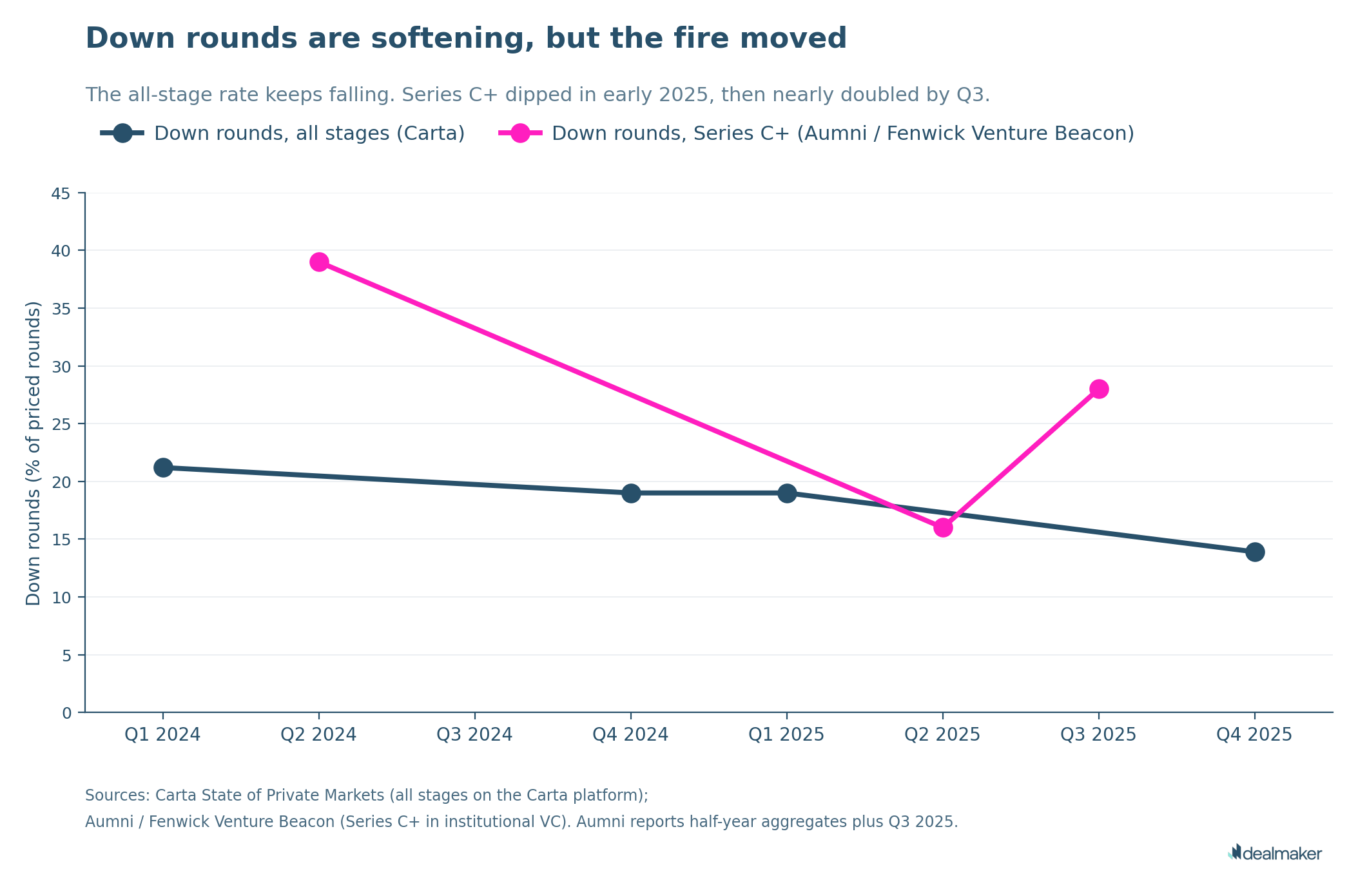
According to Carta data from Q1 2023, compared to Q1 2022:

3.5×
More Down Rounds
Down rounds increased significantly year-over-year in early 2023
20%
Of All Funding Rounds
Nearly a fifth of all funding rounds were down rounds in Q1 2023
15.6%
Participating Preferred Stock
Up from just 6.5% in Q1 2022, indicating investor-favorable terms
Growth in Online Capital Raising
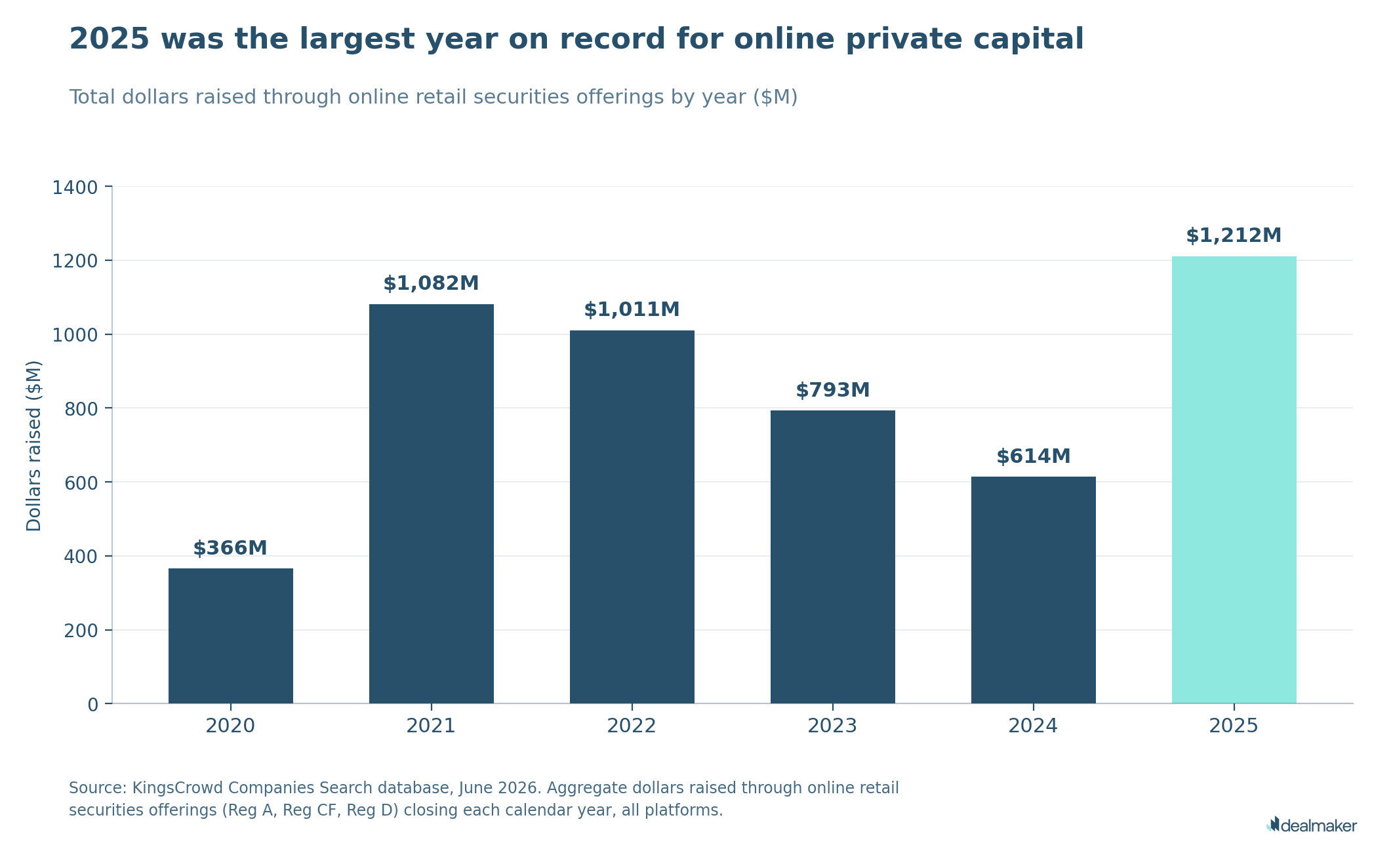
While VC deals declined, equity crowdfunding showed steady YoY growth

Source: Carta, State of Private Markets, Q1 2023

By raising capital online, founders can avoid the "Valley of Death," offer shares to their communities, and set their own deal terms (including valuation, share type, and more).

Founders that raise from their communities can stay in the driver's seat, often setting the terms of their offering with more flexibility than they might have under current market conditions.

Founders using Reg A+ can set their own terms

What deal terms founders can control under Reg A+

VC deals aren't just fewer and farther between than usual… they're also happening on heavily investor-favored terms. Deals offering participating preferred stock jumped to a whopping 15.6% in Q1 2023 (compare that to just 6.5% in Q1 2022).

All these factors combined create a very tough funding climate for startups seeking capital. They also create an exciting opportunity for equity crowdfunding to bridge the gap.

Founders that raise from their communities can stay in the driver's seat, often setting the terms of their offering with more flexibility than they might have under current market conditions. That can include choosing to issue non-voting shares or having more say on their valuation.

So what does the future hold for this pathway to the public markets? Mark says that while adoption is currently increasing, we likely need a major household name company to take the lead before this model really takes off.

Of course, for companies of that size, the real value of a Reg A+ raise is the brand-building aspect of it. These are massive, VC-backed unicorns we're talking about; they don't need to raise money from the crowd in order to keep growing. Still, it would be an incredibly powerful community-building play, breaking down barriers for their customers and fans to share in the success of the company.

"The industry just needs to find a company that can do it right. If Instacart decided to use a Reg A—that would really accelerate adoption of the model," he said. "If an Instacart, a Canva, a Stripe-sized company did a Reg A, we'd see a much higher acceptance level. The model works; we just need the right candidates to use it."


FAQ

Can a company go from Reg A+ straight to Nasdaq?

Yes. A company can raise capital under Regulation A+, then apply to list on Nasdaq once it meets the exchange's listing standards, including the public float requirement. Monogram Orthopaedics did this in 2023, and Newsmax followed a similar path to the NYSE in 2025.

How long does it take to go from Reg A+ to a Nasdaq listing?

Typically 18 to 24 months: roughly 6 months to qualify with the SEC and complete the raise, 6 months for operational readiness, and about 12 months for the exchange application and approval process.

What are the downsides of the Reg A+ to Nasdaq path?

Reg A+ raises are capped (currently $75 million under Tier 2), the offering still requires SEC qualification and ongoing disclosure, and a later listing depends on meeting exchange standards like the public float rule, which isn't guaranteed. Outcomes vary by company and market conditions.

Is Reg A+ cheaper than a traditional IPO?

It can be. Reg A+ avoids some of the underwriting commissions typical of an S-1 IPO, but companies still pay for legal, accounting, marketing, and compliance costs, and take on standard public-company reporting costs after listing.

Did the Nasdaq public float rule change affect this pathway?

Yes. Since April 2025, companies completing an IPO or uplisting to Nasdaq must meet the public float requirement solely with proceeds from the current offering rather than prior private placement shares, making the size of the Reg A+ raise itself more important to a later listing.

Ready to explore a Reg A+ raise? See DealMaker's offering types or learn why founders choose DealMaker.

LEARN MORE » Watch a replay of our recent webinar, “Path To Going Public: Reg A To Nasdaq IPO”

DealMaker Logo

The ultimate technology for raising capital online

Talk to the experts

Get the latest updates

Sign up for our monthly newsletter so you don't miss a thing.

Your submission has been received. We will reach out to you via email to schedule a call.
Oops! Something went wrong while submitting the form.