November 19, 2026
Is Equity Crowdfunding Still Worth It in 2026?
Yes, equity crowdfunding is still worth it in 2026 as a fundraising strategy. Despite a challenging market, Reg CF and Reg A offerings generated a combined $190.5 million in reported funding in Q3, with Reg A growing 13% quarter over quarter.
The industry is getting better at identifying which companies are a good fit for crowdfunding. Founders and platforms are becoming more selective about which opportunities to pursue, recognizing that a successful raise takes more than a compelling business idea.
For companies with a strong investment story, a reachable investor audience, and a clear fundraising strategy, equity crowdfunding remains a valuable way to raise capital and turn supporters into shareholders.
Key Takeaways
- Equity crowdfunding remains a viable funding strategy in 2026. Reg CF and Reg A raises brought in $190.5 million in Q3 2026, and Reg A grew 13% from the previous quarter.
- Most raises hit their target. 102 of 164 Reg CF rounds that closed in Q3 with known outcomes (62%) reached their minimum.
- The opportunity extends beyond the raise. Bringing customers and supporters onto your cap table can create opportunities for deeper engagement, advocacy, and long-term relationships.
- Preparation matters more than ever. Companies with a compelling investment story, a credible investor-acquisition strategy, and realistic fundraising economics are better positioned to pursue a successful raise.
- Choose the right fundraising structure. Reg CF permits raises of up to $5 million in 12 months, while Reg A+ allows up to $75 million, with different preparation and reporting requirements.
What Do the 2026 Equity Crowdfunding Numbers Actually Show?
Here's where the market stood in Q3 2026:
| Funding measure | Q3 2026 | Change from Q2 2026 | Change from Q3 2025 |
|---|---|---|---|
| Reg CF | $54.7M | N/A | −44.6% |
| Reg A | $135.8M | +13.0% | −19.8% |
| Combined | $190.5M | +1.9% | −28.9% |
Source: KingsCrowd. The figures represent reported funding activity, not necessarily settled proceeds. Its Reg A coverage excludes many fractional-asset offerings.

The 2026 data reveals a crowdfunding market that's changing, not disappearing.
Reg CF had a slower year but rebounded in September. Reg A moved the other way, supplying 71.3% of all Q3 funding.
Industry totals describe the market. They don’t tell you what your company can raise.
Why Equity Crowdfunding Still Matters in a Concentrated Funding Market
The fundraising landscape is changing. Venture capital is increasingly focused on AI, borrowing can be expensive, and the equity crowdfunding industry is becoming more selective about which companies are a good fit.
Four developments help explain why the crowdfunding landscape looks so different in 2026:
Market Shift 1: Venture capital has become an AI-heavy business
Remember when every startup pitch needed a blockchain angle? These days, artificial intelligence is doing much of the fundraising heavy lifting.
According to Crunchbase's Q1 2026 report, AI companies attracted $242 billion, roughly 80% of the $300 billion invested globally that quarter.
Four companies, including OpenAI and Anthropic, accounted for $188 billion. Those are extraordinary numbers, even by Silicon Valley standards.

Record-breaking VC investment doesn't necessarily mean more funding opportunities for every type of company, particularly for founders outside the biggest AI deals.
A consumer brand, manufacturer, or regional business can have strong fundamentals and a loyal customer base without fitting a traditional venture fund's investment thesis.
That's where equity crowdfunding offers a different path.
Rather than relying exclusively on institutional investors, eligible companies can invite customers, supporters, and other investors to participate in their growth.
And the two approaches aren't mutually exclusive.
Why Choose Between VC and Your Community?
Consider Aura Health. The mental wellness platform had already secured venture investment before raising $6.3 million across three community campaigns, bringing more than 2,600 investors into the business.
Its co-founder and CEO, Steve Lee, describes the relationship between the two funding sources:
"Looking back, blending VC and community capital was one of the best strategic decisions we made. It's not either/or. It's both, and each makes the other more valuable."

For a broader comparison, read The Founder's Guide to Alternatives to Venture Capital.
Market Shift 2: Crowdfunding is consolidating around fewer platforms
The concentration isn't limited to VC.
In Q3 2026, DealMaker Securities, Wefunder, and StartEngine accounted for 82.4% of reported Reg CF funding, up from 71% a year earlier, according to KingsCrowd. DealMaker led the group with $18.28 million, followed by Wefunder at $17.35 million and StartEngine at $9.44 million.

That’s what a maturing industry looks like: capital flowing to platforms with a track record of delivering. For founders, the better question isn’t who’s biggest. It’s which model fits your raise.
Ask: Who helps you find investors? Who handles compliance? What will it cost? Who owns the investor relationship after the raise?
That last question mattered to Timeplast. After raising $5 million from 9,733 retail investors on DealMaker, the materials science company had a direct line to thousands of potential customers. When it launched its sustainable straws, a single email to its investor list sold 10,000 units in six hours. Founder Manuel Rendón said the platform let the company "own the data and build a direct relationship with the people backing us."
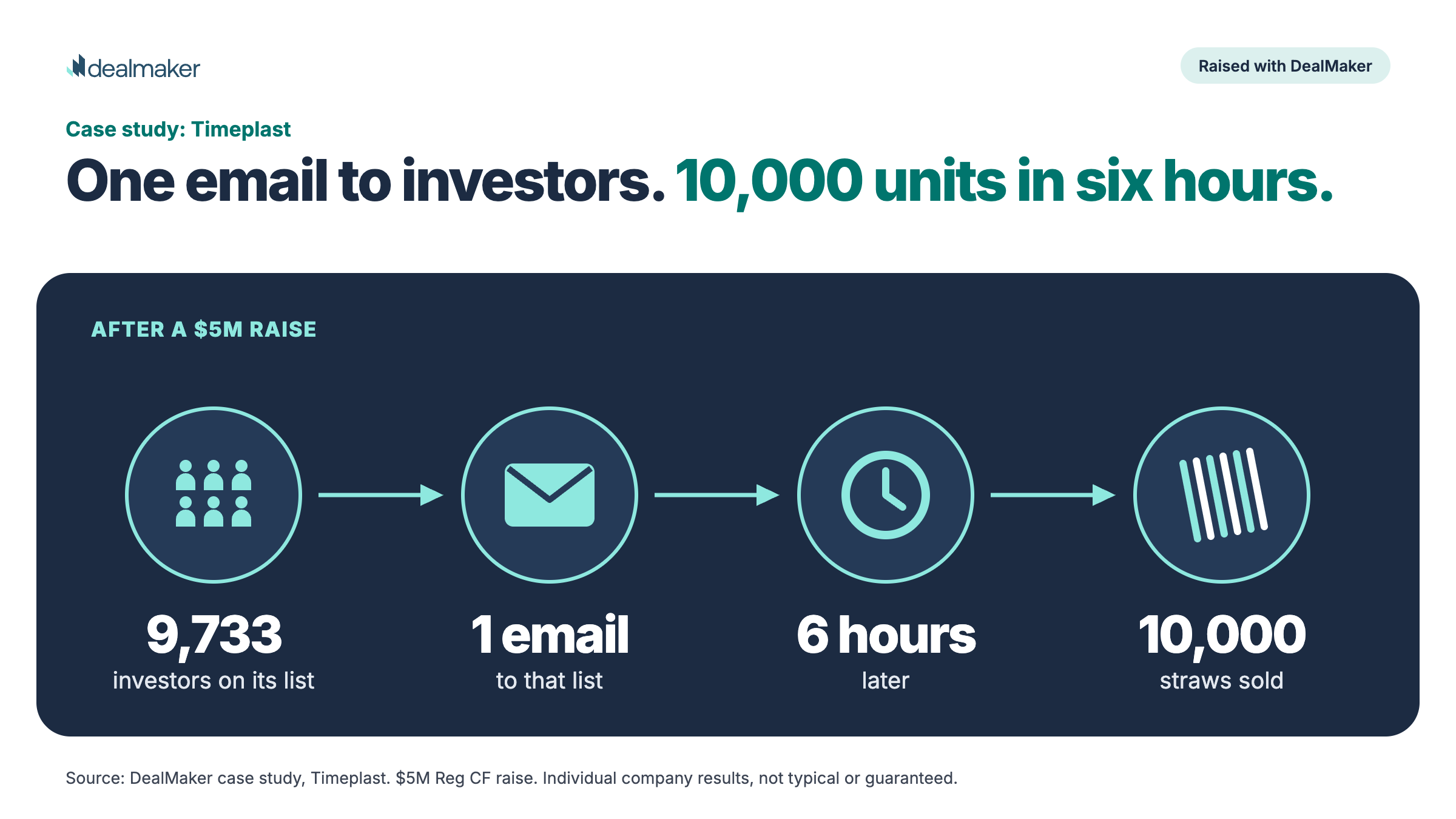
The equity crowdfunding platform you choose can shape what happens long after the raise closes.
Market Shift 3: Regulators are reconsidering who gets access to private equity markets
While private capital is concentrating, the regulatory debate is moving toward wider access, even though the rules haven’t all changed yet.
In September 2026, the SEC proposed measures intended to broaden access to private-market investments through regulated funds.
Separately, it requested public comment on new routes to accredited-investor status, including a potential exam administered through FINRA rather than qualification based only on wealth or income and existing credentials.
This means that investor eligibility might eventually depend less exclusively on wealth and more on demonstrated financial knowledge.
But these are proposals, not expanded eligibility founders can rely on today. Reg CF already permits eligible non-accredited investors to participate, subject to investment limits.
Still, the direction of the conversation matters.
As private markets become increasingly important, regulators are considering how more people might participate, not whether everyday investors should be excluded altogether.
Market Shift 4: The Cost of Debt Is Changing the Fundraising Equation
Debt financing can help companies raise capital without giving up ownership, but borrowing comes with interest payments, repayment obligations, and eligibility requirements.
For businesses facing expensive borrowing terms or limited access to credit, equity crowdfunding offers another way to finance growth without taking on scheduled debt repayments.
That doesn't make equity capital cheaper by default. It gives founders another option to weigh against the cost, flexibility, and obligations of traditional financing.
Wondering if a raise could work for your company?Talk to DealMaker about your audience, your target, and the right offering type.
Talk to DealMakerSo When Is Equity Crowdfunding Worth It? And When Isn't It?
Crowdfunding is more likely to make sense when people already care about your company or you have a credible way to reach them.
Equity Crowdfunding Pros and Cons
| Equity crowdfunding is a strong fit if | What to plan for |
|---|---|
| You have an engaged customer base or credible investor-acquisition plan. | How to reach and convert prospective investors |
| You can explain the business, its risks, and what new capital will accomplish. | How to communicate the opportunity, risks, and business fundamentals |
| You have the budget and team capacity to run a campaign. | Campaign preparation, marketing, and execution |
| Your funding target and offering terms make economic sense. | Offering terms, expenses, and net proceeds |
| You're prepared to communicate with investors after the raise. | Ongoing communications, reporting, and shareholder management |
An existing customer base can provide a valuable starting point, but it's not the only route to attracting investors. Companies can also build awareness through targeted marketing, partnerships, and founder-led outreach.
The key is approaching investor acquisition as an intentional part of the fundraising strategy, rather than relying on platform discovery alone.
No audience yet? You can build one with targeted marketing, partnerships, and founder-led outreach. Just plan for it from day one.
Green Coffee Company raised more than $100 million from accredited investors, then the company opened a $5 million Reg CF round to everyday investors, bringing 2,111 shareholders into the business. It then offered shareholders a discount on its coffee, generating thousands of online orders. Green Coffee Company wasn't turning to retail capital because traditional investors were unavailable. It saw an opportunity to bring consumers into the business as owners, too.

There's evidence that interest can extend beyond experienced private investors. In DealMaker's 2026 Retail Investing Survey Report, 54% of 2,009 U.S. adults said they'd like more opportunities to invest in private companies; separately, 71% said they wouldn't know where to look.

Those findings don't prove people will invest in a specific company. They do suggest awareness and discovery deserve a place in any fundraising plan.
Retail investors ask the same questions VCs do about valuation, dilution, and risk. Founders who answer them clearly build trust, and often repeat investors.
How Much Do Successful Equity Crowdfunding Campaigns Realistically Raise?
Equity crowdfunding campaigns can raise anything from relatively modest amounts to millions of dollars. The right funding target depends on what a company needs to accomplish.
KingsCrowd examined 164 Reg CF rounds with Q3 2026 closing dates and known outcomes. Of those, 102 succeeded, 49 missed their minimum targets and had to refund investors, and 13 were withdrawn. Among the 100 successful rounds with positive reported funding, 69 raised less than $250,000.
The median was approximately $124,000, while the average was about $418,000, reflecting the influence of a smaller number of larger raises.
These figures illustrate the range of fundraising outcomes, not a universal equity crowdfunding success rate. The sample also includes debt offerings.
A successful raise isn't necessarily the largest raise. It's one that provides the capital a company needs to reach a meaningful business milestone.

For one company, $150,000 might fund a critical product launch or expansion. For another, a multimillion-dollar raise may be necessary to execute its growth strategy.
The most useful measure of success is whether the capital raised, after expenses, supports the company's objectives.
Reg CF vs. Reg A in 2026: Which Is the Better Fit?
The two exemptions are often thrown together under “equity crowdfunding,” but they aren't interchangeable. Both can make securities available to everyday investors, yet they come with different ceilings and obligations.
| Reg CF | Reg A+ | |
|---|---|---|
| Maximum raise | $5M in 12 months | $75M in 12 months |
| Before launch | File Form C and use a registered intermediary | File Form 1-A and obtain SEC qualification before sales |
| Financial and reporting requirements | Disclosure and financial-statement requirements vary; annual reporting generally applies | Audited financials and ongoing annual, semiannual, and certain event reports |
| Time and cost | Generally less involved, though legal, platform, and marketing costs still matter | Typically more preparation and greater professional-services costs |
| Best starting question | Can a smaller raise fund our next meaningful milestone? | Do we need a larger raise, and can we support a more demanding process? |
Sources: SEC Regulation Crowdfunding and SEC Regulation A. Actual preparation times and costs vary by issuer.
Reg A’s scale is real, and so is its concentration. Three companies (Frontieras North America, Mode Mobile and EnergyX) drove nearly 59% of tracked Reg A funding in Q3.
Frontieras raised $71.4 million cumulatively across Reg CF and Reg A over several years.
Choose the exemption that fits your business and the capital you need, not the one producing the biggest headlines.
Read the case studies
How Does Equity Crowdfunding Compare With Other Funding Options?
| Funding option | Potential advantage | Important consideration |
|---|---|---|
| Equity Crowdfunding | Access to retail investors and the opportunity to engage customers as shareholders | Requires marketing, compliance, and ongoing investor management |
| Venture Capital | Institutional capital, strategic guidance, and potential access to networks | Depends on investor fit, growth expectations, and negotiated ownership terms |
| Debt Financing | May preserve ownership | Repayment obligations and eligibility requirements |
| Angel Investors | Potentially flexible funding and individual investor expertise | Investor availability, check sizes, and terms vary |
Frequently Asked Questions About Equity Crowdfunding in 2026
Is now a bad time to crowdfund?
How much can a company realistically raise?
What percentage of crowdfunding campaigns fail?
How much does an equity crowdfunding campaign cost?
Can I crowdfund without an existing audience?
Is Reg A+ worth the additional cost?
Will crowdfunding hurt my chances of raising VC later?
What are the best platforms for raising capital from my customers and community?
DealMaker, Wefunder, and StartEngine are among the leading options, but they take different approaches. Unlike investor marketplaces such as Wefunder and StartEngine, DealMaker puts your raise on your own branded website, so your customers invest with you, not with a portal next to everyone else.
DealMaker also lets you keep your investor relationships and data. Compliance, shareholder administration, and marketing services are built in, so you can run your raise with one partner instead of stitching together several. In Q3 2026, DealMaker Securities led both Reg CF and Reg A+, according to KingsCrowd, handling a third of all Reg CF dollars and more than 80% of Reg A+ dollars.
So, Is Equity Crowdfunding Still Worth It?
Yes. “Crowdfunding is dead” is a lazy take. Reg A grew, most Reg CF rounds hit their minimum, and companies like Aura Health, Timeplast, and Green Coffee Company raised community capital alongside VC and accredited investors. Timeplast and Green Coffee Company then turned those investors into customers.
The market has changed, but the fundamental opportunity hasn't disappeared.
Companies can still raise capital from customers, supporters, and investors beyond traditional funding networks. They can also build relationships with shareholders who may become long-term advocates for their businesses.
So skip the industry-wide verdict. Ask whether crowdfunding works for your company.
Before deciding, consider four factors:
- Funding target: How much capital do you need to achieve your next milestone?
- Audience: Who might invest, and how will you reach them?
- Economics: What will the raise cost, and how much capital will remain after expenses?
- Strategy: How does crowdfunding compare with VC, debt, and other financing options available to your business?
Then compare Reg CF and Reg A with VC, debt, and your other funding options. Look at what you'll actually take home, what ownership you're giving up, and what the capital will help you accomplish.
Equity crowdfunding won't be the right choice for every founder. But for companies prepared to approach it strategically, it remains an opportunity worth exploring.
Could equity crowdfunding work for your business? Talk to DealMaker about what a raise could look like.
Related Resources
Explore Retail Capital Raising
Explore Broader Funding Strategies
- The Founder's Guide to Alternatives to Venture Capital
- How Founders Keep Board Control While Raising Capital
Sources
- KingsCrowd: Reg A growth helps crowdfunding reach $190.5 million in Q3 2026
- KingsCrowd Reg CF markets data
- KingsCrowd Reg A markets data
- Crowdfund Insider: Reg CF contracted dramatically in Q1 2026
- AI startups capture 81% of global VC funding in Q1 2026
- Verdict Capital, Atomico warn five AI firms took 75% of VC
- King & Spalding: SEC proposes rule changes to facilitate retail access to private investments
- American Banker: SEC rule would let investors take exam to qualify as accredited
- LenderKit: US Equity Crowdfunding in 2026: Reg A vs Reg CF, Data Shock, Transparency Crisis