Raise Capital
Products
Resources

December 15, 2025
Managing investor relationships used to be straightforward. You had a handful of institutional LPs, you sent them quarterly updates, and the relationship stayed relatively stable. That world no longer exists. Today’s growth-stage companies are raising from a mix of retail investors, accredited individuals, institutional funds, and strategic partners. They’re running multiple concurrent offerings under different regulatory frameworks. They’re managing thousands of investor touchpoints across email, portals, and direct communication channels. And they’re trying to do all of this while maintaining strict SEC compliance and building lasting investor communities that compound in value with each raise. An automated investor CRM acts as a true partner in managing these complex investor relationships, supporting teams as they scale and streamline operations.
Traditional CRM systems weren’t built for this reality. They’re designed for sales pipelines and customer service workflows, not the unique demands of investor relations. That’s where automated investor CRM systems come in. These platforms combine the relationship tracking power of standard CRM with compliance-first architecture, investor lifecycle management, and automation workflows purpose-built for capital raising. By consolidating all investor relations tools and data into one platform, automated investor CRMs enhance efficiency and provide a single source of truth for IR teams.
The companies building permanent fundraising engines aren’t just raising capital more efficiently. They’re transforming how they think about investor relationships entirely. Automated investor CRM streamlines fundraising efforts by tracking investor interactions, targeting high-potential LPs, and providing actionable insights, enabling teams to focus on high-impact activities.
Generic CRM systems can track basic information. They can log calls, store documents, and send automated emails. But investor relations and relationship management are fundamentally different from sales or customer service. The stakes are higher. The regulatory requirements are more complex. The relationship lifecycle is longer and more nuanced. And the data you need to track is highly specific.
The Compliance Problem
A standard CRM tracks whether a prospect is qualified, how many times you’ve contacted them, and whether they’re likely to close. An investor CRM needs to track whether an investor is accredited, which offering documents they’ve reviewed, whether they’ve completed KYC verification, which regulatory framework governs their investment, and whether they’ve received all required disclosures. It needs to maintain audit trails that prove compliance with SEC regulations. It needs to flag when accreditation status needs renewal. It needs to ensure that material information isn’t disclosed to some investors while being withheld from others.
The SEC’s Investor Advisory Committee has emphasized that investors should be entitled to basic, unbiased, material information before they invest in a company, and then on an ongoing basis related to their investments. This isn’t just a best practice. It’s a regulatory requirement. A system that doesn’t bake compliance into its core architecture leaves your company exposed to serious risk.
The Scale Challenge
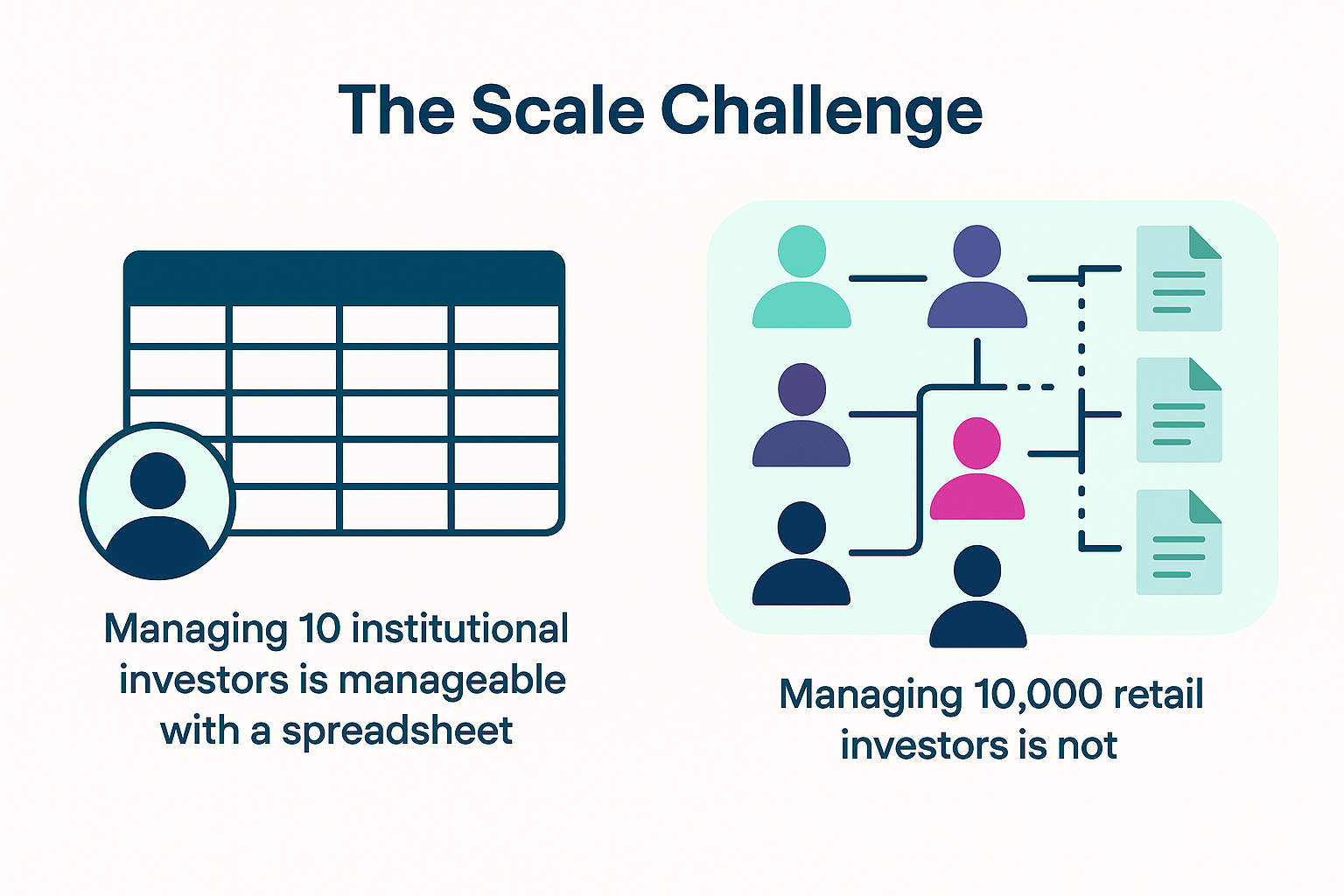
Managing 10 institutional investors is manageable with a spreadsheet. Managing 10,000 retail investors is not. The moment you move from episodic fundraising to continuous capital raising, the complexity multiplies. You have investors at different stages of the journey: some who are prospects, some who are considering, some who have committed, some who are existing shareholders. You have different communication needs for each segment. You have different document requirements based on the regulatory framework. You have different engagement strategies based on investor type and investment size.
Harvard Business Review research shows that managers often approach investor relations as a marketing exercise, pitching the company’s business and strategy to as broad of an audience as possible. But that dragnet approach breaks at scale. When you have thousands of investors, you need segmentation, personalization, and targeted communication. You need to know which investors are most engaged, which are at risk of becoming inactive, and which are most likely to invest again. A generic CRM can’t provide this level of intelligence.
The Data Silo Problem
Most companies manage investor data across multiple disconnected systems. Cap table software tracks ownership. Accounting systems track distributions. Email platforms track communications. Document management systems store offering materials. Compliance software tracks accreditation status. When your investor data lives in silos, you lose visibility. You can’t see the complete investor journey. Maintaining the entire communication history with each investor is crucial for better relationship management and engagement insights. You can’t identify patterns. You can’t automate workflows that require data from multiple systems. And you create compliance risks when different systems have conflicting information.
According to PwC’s 2024 Global Investor Survey, business leaders are expected to communicate to investors what is material to their business, doubling down on transparency and consistency to ensure they are building trust through communication. But you can’t communicate consistently when your data is fragmented across systems. A modern capital raising platform provides actionable insights and solves this by centralizing investor data and communication in one system. Consolidating data and workflows in a single platform increases efficiency for IR teams.
The Communication Complexity
Investors today expect transparency with insider information rules. They want regular updates but not information that would constitute material non-public information. They want personalized communication but consistent messaging. They want to feel like valued partners but understand that they’re one of thousands. Balancing these competing demands requires sophistication that generic CRM systems simply don’t provide.
An automated investor CRM is fundamentally different from a standard CRM. It's built from the ground up to handle the unique requirements of investor relations at scale.
In today’s competitive fundraising landscape, investor targeting and outreach are foundational to a successful investor relations strategy. Rather than casting a wide net, leading firms leverage investor relationship management software to identify and engage with potential investors who are the best fit for their business objectives. By consolidating investor data into a single system, IR teams can analyze past engagement, investment preferences, and relationship history to develop a focused outreach plan.
This data-driven approach to investor targeting enables firms to prioritize high-potential prospects, personalize communications, and build meaningful relationships that go beyond transactional interactions. Proactive insights generated by the platform help teams anticipate investor needs, tailor messaging, and time their outreach for maximum impact. As a result, firms can minimize risk by concentrating their efforts on the right investors, increasing efficiency, and driving more deals through the fundraising process.
By streamlining outreach and consolidating all relevant data, IR teams can focus on high-impact activities that foster long-term relationships and support the overall investor relations strategy. The result is a more strategic, efficient, and effective approach to investor engagement—one that delivers measurable results and positions the firm for sustained success.
The real power of an automated investor CRM is automation. These workflows run in the background, executing the right action at the right time without manual intervention.
Onboarding Sequences
When a new investor commits, an automated sequence is triggered: welcome email, educational drips about your company, KYC verification request, accreditation confirmation, document distribution, and ongoing updates. This sequence happens automatically, consistently, and at scale. Every investor gets the same high-quality onboarding experience regardless of how busy your team is.
Nurture Campaigns
Prospects who haven't invested yet receive automated nurture campaigns based on their engagement level and interests. Early-stage prospects get educational content about your company and your capital raising strategy. More engaged prospects get deeper dives into your business model and market opportunity. Prospects showing high intent get invitations to exclusive events or one-on-one conversations with your team. Investor acquisition strategies should focus on moving prospects through the funnel systematically rather than trying to close everyone at once.
Re-Engagement Strategies
Investors who haven't engaged in a specified period trigger automated re-engagement campaigns. These campaigns remind them of their investment, highlight recent company milestones, and invite them to upcoming events. For investors who might be candidates for the next raise, the system identifies them and activates a specific re-engagement sequence designed to prepare them for the next opportunity. Building community capital means treating repeat investors as your most valuable assets.
Event-Triggered Communications
Certain events automatically trigger communications: investment anniversaries, distribution payments, company milestones, upcoming offering deadlines, accreditation renewal dates. Rather than manually tracking these dates and sending emails, the system handles it automatically. This ensures that important moments never slip through the cracks.
Compliance Automations
The system automatically tracks accreditation renewal dates and sends reminders to investors who need to re-verify their status. It monitors regulatory changes and flags when your processes need updating. It generates compliance reports showing that you're following SEC rules. It maintains documentation proving that all required disclosures were made.
Performance Reporting
Automated quarterly reports are generated and distributed to investors showing company progress, financial performance, and key metrics. Rather than manually compiling data and creating reports, the system generates them automatically from your core business data. Investors receive consistent, timely updates without your team spending hours on reporting.
The most sophisticated use of an automated investor CRM goes beyond managing individual relationships. It's about building communities.
Personalization at Scale
A purpose-built investor relationship management software CRM enables personalization that would be impossible to achieve manually. Each investor sees content tailored to their interests and investment stage. First-time investors see different messaging than repeat investors. Accredited investors see different opportunities than retail investors. Investors who've been with you for years see different communications than new investors. This personalization happens automatically based on investor attributes and behaviour.
Engagement Scoring
The system automatically scores investor engagement based on activity: emails opened, documents reviewed, events attended, questions asked, and investment history. This scoring identifies your most engaged investors (your champions) and your at-risk investors (those showing declining engagement). Your team can then focus outreach efforts on the right investors at the right time.
Community Features
Modern investor CRMs include community features that create connections among your investor base. Investor forums enable discussion. Exclusive events create networking opportunities. Peer introductions facilitate investor-to-investor relationships. This community aspect transforms your investor base from a collection of individuals into a genuine community with shared interest in your success.
Referral Programs
Automated referral tracking enables structured programs that reward investors for bringing in new investors. The system tracks referrals, calculates rewards, and distributes them automatically. This turns your most engaged investors into active advocates for your company.
Feedback Loops
Automated surveys and feedback requests gather investor input on your company, your communication, your strategy. This feedback is collected systematically and analyzed to identify patterns. You learn what's resonating with investors and what needs improvement. You can respond to investor feedback demonstrably, showing that you're listening and adapting.
Building Repeat Investors
The ultimate goal of investor CRM is building repeat investors. Companies that retain investors for follow-on rounds dramatically reduce future fundraising friction. According to KingsCrowd data, companies that successfully engage their existing investor base see significantly higher conversion rates on follow-on offerings. An automated investor CRM makes this possible by maintaining relationships between raises, tracking investor interest in future opportunities, and executing re-engagement campaigns when new offerings launch.
LiquidPiston's approach to building repeat investor engagement demonstrates how leading brands use systematic investor CRM practices to enable companies to raise across multiple consecutive rounds.
Implementing an automated investor CRM requires investment, but the returns are substantial.
Cost Analysis
Manual investor management is expensive. Your team spends time tracking investor data, sending communications, managing documents, ensuring compliance, and reporting. On average, CEOs allocate 15 days per year to investor relations activities, and CFOs and investor relations professionals spend even more time. A purpose-built investor CRM can save 20+ hours per week by automating routine tasks, reducing manual data entry, and eliminating duplicate work across systems.
Compliance Risk Reduction
The cost of compliance failures is severe. SEC penalties, reputational damage, and legal liability can be devastating. An investor CRM that embeds compliance into every process dramatically reduces risk. It maintains audit trails proving compliance. It flags potential issues before they become problems. It ensures consistent application of compliance rules across all investors.
Investor Satisfaction
Investors expect professional, timely communication. They want to see their investment tracked accurately. They want access to information when they need it. A purpose-built investor CRM delivers this consistently. A Harvard Business School study found that companies actively engaging in investor relations are 50% more likely to attract long-term investors. This translates directly to higher retention rates and higher conversion rates on follow-on raises.
Implementation Timeline
A well-executed implementation typically takes 30 days from setup to full operation. During this period, your team works with the platform provider to configure the system for your specific needs, migrate existing investor data, integrate with your other systems, and train your team. After implementation, the system is immediately operational and generating value.
Platform Selection Criteria
When evaluating investor CRM platforms, look for several key capabilities: robust compliance features, scalability to handle thousands of investors, integration with your existing systems, ease of use for your team, and strong support from the vendor.
Migration Strategies
Moving from spreadsheets to a sophisticated investor CRM requires careful planning. Start by auditing your existing investor data to understand quality and completeness. Plan a phased migration where you bring investors into the system in waves rather than all at once. This reduces risk and allows your team to learn the system while managing a smaller initial dataset. Run parallel processes for a period where you maintain both the old system and the new system to ensure nothing falls through the cracks. DealMaker's guide hub provides resources on implementing modern capital raising infrastructure.
The transition from manual investor management to automated investor CRM represents a fundamental shift in how companies approach investor relations. Rather than treating investor management as a periodic activity that spikes during fundraising, companies are building permanent infrastructure that manages investor relationships continuously.
The companies raising the most capital aren't just executing better fundraising campaigns. They're building permanent investor communities that compound in value with each raise. They're maintaining relationships between offerings so that the second raise is easier than the first, the third easier than the second. They're using investor data strategically to identify patterns, optimize communication, and build lasting partnerships.
An automated investor CRM makes this possible. It provides the infrastructure to manage thousands of investors professionally, compliantly, and at scale. It automates the routine tasks that consume so much time, freeing your team to focus on strategy and relationship building. It embeds compliance into every process, reducing risk. It enables personalization and segmentation that creates genuine connection with your investor community.
For founders and CFOs evaluating investor management infrastructure, the question isn't whether to modernize. It's how quickly to move. The companies building permanent fundraising engines are already doing this. The question is whether your company will follow.




.png)