Raise Capital
Products
Resources

August 17, 2026
Wall Street just decided that access, not just returns, is the pitch worth making. In July 2026, Goldman Sachs consolidated its alternatives business into a single private markets platform, giving wealthy clients direct pre-IPO stakes in companies like SpaceX, Stripe, and Canva before they go public. Kristin Olson, Goldman's global head of alternatives for wealth, put it plainly: there's "a lot of focus on the big growth tech names and getting clients access to those before they debut in the public markets." If even Goldman Sachs is now selling access to private markets as the product, the question every founder should be asking isn't just "how do I raise money without VC," it's "why is access to growth-stage companies suddenly the thing everyone wants, and who gets to have it."
Right now, the answer is: whoever qualifies as an accredited investor. Goldman's platform, like most private markets access, is restricted to accredited investors, qualified purchasers, and family offices. That threshold was set in 1982 under Regulation D, at $1 million in net worth or $200,000 in individual income, and it has never been adjusted for inflation. The SEC's own 2023 staff report found that just 1.81% of households qualified in 1982, versus 18.5% by 2022, a 16-fold increase driven almost entirely by inflation eroding the original number rather than by any change in the rule itself. Adjusted for inflation, that $1 million threshold would be closer to $3 million today. Investors including Brad Gerstner have made this critique publicly on shows like All-In: the rule gatekeeping access to private markets is a decades-old net worth test that was never designed for today's dollars, and it decides who gets to invest in the next SpaceX and who doesn't.
Founders should care about this for a different reason than investors do. If access to capital increasingly depends on who counts as "accredited," then non-dilutive and less-dilutive alternatives to venture capital aren't just a fallback for companies that couldn't raise VC, they're one of the only paths that lets founders raise from people who aren't wealthy enough to qualify as accredited investors in the first place. That's the gap this guide is built to close.
Founders usually hear about these options one at a time, from different sources, with no way to compare them side by side. Here's all five in one place.
The retail capital row covers three separate regulations, and the differences matter. Reg CF caps a raise at $5 million in any 12-month period and is open to non-accredited investors. Reg A+ allows up to $20 million a year under Tier 1 or $75 million under Tier 2, also open to non-accredited investors, which is what makes it the closest thing to Goldman's platform that doesn't require being wealthy enough to qualify as accredited. Reg D has no offering cap at all, but 506(c) restricts the raise to accredited investors only, the same gate Goldman's platform sits behind. DealMaker's overview of all three is the fastest way to see which one fits a given raise size and investor base.
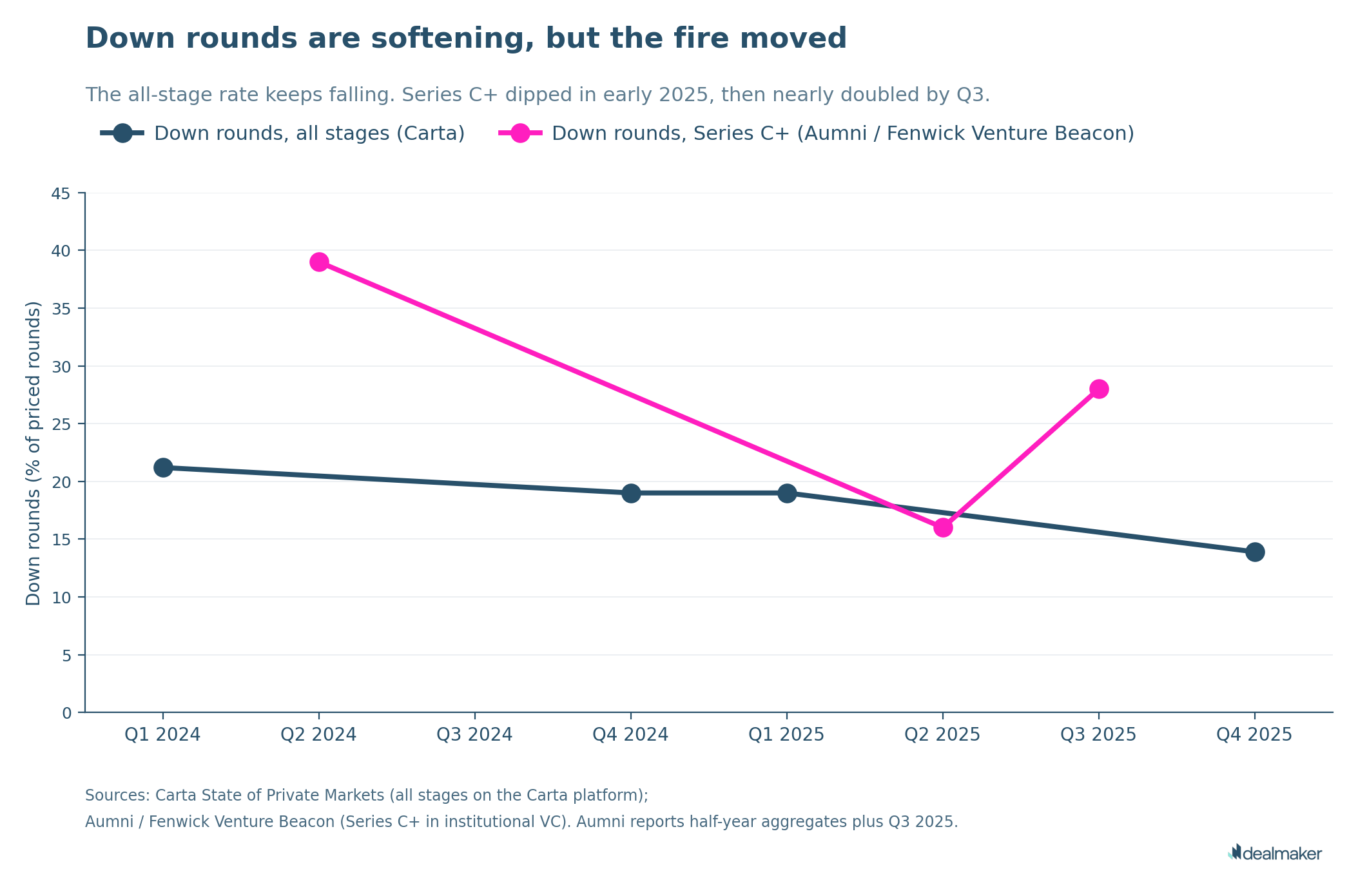
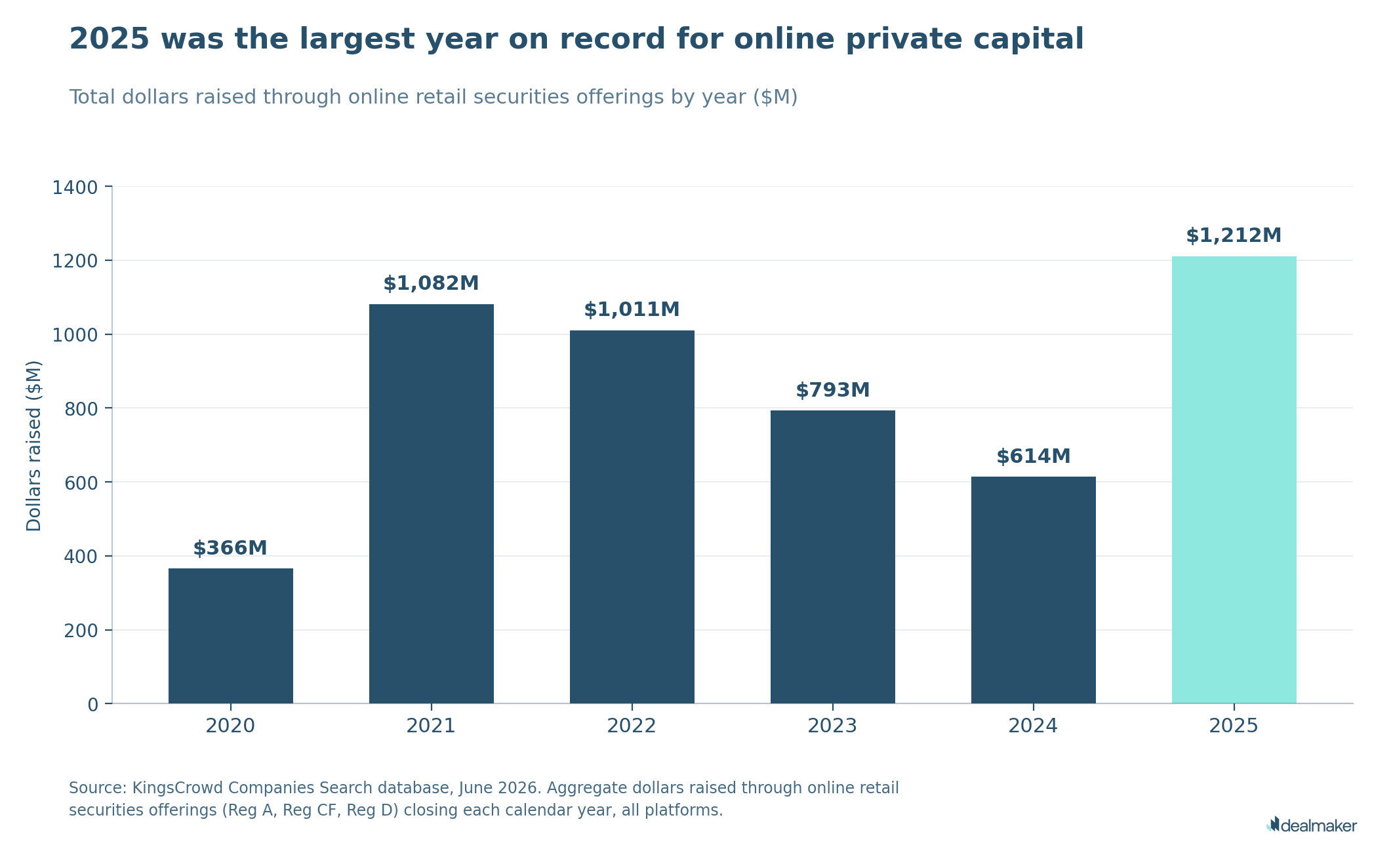
Private markets access is opening up, but not evenly. Venture capital itself has kept flowing, just not to every category of company, and even companies that do raise VC successfully are finding follow-on capital harder to secure in categories VCs have rotated away from. At the same time, the pool of capital sitting in retail investors' hands dwarfs the entire venture market, and institutional gatekeeping that used to wall off growth-stage access is cracking at the top of the market and starting to crack in the middle of it too. Goldman built infrastructure to give its wealthiest clients a way in. Equity crowdfunding under Reg A+, Reg CF, and Reg D is the infrastructure that already gives everyone else a way in, non-accredited investors included, and DealMaker has been running that infrastructure long enough to know its mechanics cold.
None of these five options are mutually exclusive, and treating them that way is usually the mistake. Diversifying the capital stack, bootstrapping to extend runway, layering in venture debt between equity rounds, and opening part of a raise to retail capital, gives a company benefits none of those sources provide on their own: cost efficiency, speed, and a customer base that's also a cap table.
A few starting points. If you're cash-flow positive or close to it, bootstrap as long as you can before giving up anything. If you have predictable recurring revenue and want to avoid dilution entirely, revenue-based financing or venture debt are worth pricing out before an equity round. If your product fits a specific government or foundation program, grants are free money, but budget months for the process, not weeks. If you have an engaged customer base and want capital that also builds distribution, retail capital is worth structuring in as part of the round, not a fallback if VC falls through. Pacaso is the clearest example on the record: the company raised $200M from VCs, then deliberately raised another $72.5M from 17,500 retail investors rather than going back to VCs for more.
The founders who avoid a down round later, and who keep the board seats and control decisions covered elsewhere in this series, are usually the ones who built more than one of these five into their capital stack before they needed to. DealMaker's full guide to raising capital online covers what building that stack looks like end to end.





.png)