Raise Capital
Products
Resources

May 7, 2026
By Aaron Shafton, Managing Director at DealMaker Securities
The numbers at a glance:
The IPO window reopened in Q1. Here's what happened to the companies that got through it, and what it means if you're counting on an exit to justify your next round.
In July, Figma went public at $33 per share with a market cap of $19.3B. The stock peaked with a market cap of ~$60B on its second day of trading, and settled to around $9.1B by April 2026. 85% off peak, 53% off IPO price, in nine months (Stock Analysis; Secfi). The drawdown reflected more than mood. Public markets were pricing in a concrete risk: a single Anthropic or OpenAI release could compress Figma's category overnight.
Figma is the bullish case for the cohort. It's also the only 2025 software IPO trading above 10x EV/ARR. The median 2025 software IPO trades at 8.7x and is down 10% from its last reported private round (Meritech 2025 Technology Exits in Review). The two largest VC-backed Q1 2026 IPOs, EquipmentShare and BitGo, priced above their marketed ranges in January and saw initial enthusiasm fade in weeks (PitchBook-NVCA). And this is the bullish read.
Public market buyers in 2026 demand profitability and scale. The median 2025 software IPO arrived at $616M in last-twelve-months revenue, 35% growth, and roughly breakeven free cash flow (Meritech). That is the floor; companies arriving without those numbers are either deferring or accepting punitive pricing on the way out.
Every Series A/B founder modeling a Series C around an IPO exit faces one question. Can the company hit those numbers by the time it gets to the door? Today, not in 2028.
47 new unicorns were minted globally in Q1 2026, 37 of them in March alone, a four-year high (Crunchbase). The same quarter produced just 15 VC-backed IPOs (PitchBook-NVCA Venture Monitor), and those 15 looked nothing like the pipeline: 40% were biotech and pharma. The Tech IPO revival faded as multiples collapsed and capital concentrated in AI (Renaissance Capital).
Motive (logistics, ~$2.85B last private valuation) was expected to be one of 2026's tent-pole IPOs. The company filed its S-1 in December 2025, but paused its roadshow mid-January because of capital concentration in AI-resistant categories. Figma, the year's largest IPO at $19.3B, has lost roughly 85% from its post-IPO peak in nine months (Stock Analysis).
The IPO penciled into your Series C pitch deck is the least reliable variable in your company's future. Series A/B founders who haven't honestly priced that risk are carrying it anyway.
What's getting through public markets in 2026 doesn't look like what's stuck in private. EquipmentShare (construction rental) listed in January reporting $40M in net income. BitGo (digital asset infrastructure) followed with $8.1M in net income on $10B in revenue for the first nine months of 2025. Both were profitable, both in sectors aligned with the current administration's policy priorities. PitchBook called the cohort "a notable shift from the platform-heavy wave of 2021, when companies went public on the promise of their science rather than the strength of their products."
Renaissance's read on the broader tape confirms it: "the prior year's tech IPO revival faded as valuation multiples collapsed amid fears of disruption from AI." Investor appetite shifted to "AI-resistant real economy businesses, especially in power infrastructure." The Renaissance IPO Index ended Q1 at -8%, underperforming the S&P 500 (-4%).
The IPO door isn't closed, it just hasn't widened for VC-backed companies in four years. Healthcare and drug discovery have absorbed 30-40% of all VC-backed IPOs every year since 2022, and the remaining listings have been small in number across software, consumer, fintech, and most other categories (Meritech). Q1 2026 didn't change that pattern. If you're not in biotech, fintech with a profit story, or AI infrastructure, you're competing for a slice of the IPO market that's averaged 4-6 listings per year for the broader category.
.png)
VC-backed IPO throughput hasn't moved off the floor in four years. The pipeline keeps adding above it. The 47 new unicorns minted in Q1 2026 join an active cohort of roughly 900 unicorns valued at $5.8 trillion in aggregate post-money (PitchBook-NVCA). Most of that inventory will never exit through public markets at anything close to its last private mark.
Motive is what tech IPO retreat looks like at the company level. When a company expected to clear the IPO bar quietly steps back, it confirms what bankers, CFOs, and secondary traders already know: the bar moved.
The version of this story most founders are telling themselves is "the market will reopen." The version the data tells is "the market reopened, you saw what happened, now look at the math again."
Companies defer, and deferral isn't free. It costs in bridge round dilution, in employee equity grants that can't liquidate, in secondary-pricing markdowns, in board patience. Companies that stay private an extra two years against an exit assumption pay across all four categories simultaneously. The cost compounds quietly until it shows up as a board agenda item.
While the company waits, the secondary market starts pricing it. Employees, early investors, and angels can sell shares on platforms like Forge and EquityZen, and the price those shares sell for is what the market thinks the company is worth today. Your VC still carries the round price on their quarterly report. The secondary buyer who picked up your early employee's shares last week carries what they paid. As deferral stretches, those numbers diverge, and the cap table sees the gap before the founder does.
Underneath both, valuation marks drift downward silently. The 2021 cohort has been getting marked down through extension rounds, pay-to-plays, and structural concessions for two years. Most boards saw the implications six months later than the cap table did, and by the time the company sees the markdown clearly, it has been paying for it for a year.
This is the cost of treating an IPO as the destination instead of one option among several.
Carta's State of Private Markets Q4 2025 tells the rest of the Series A/B story.
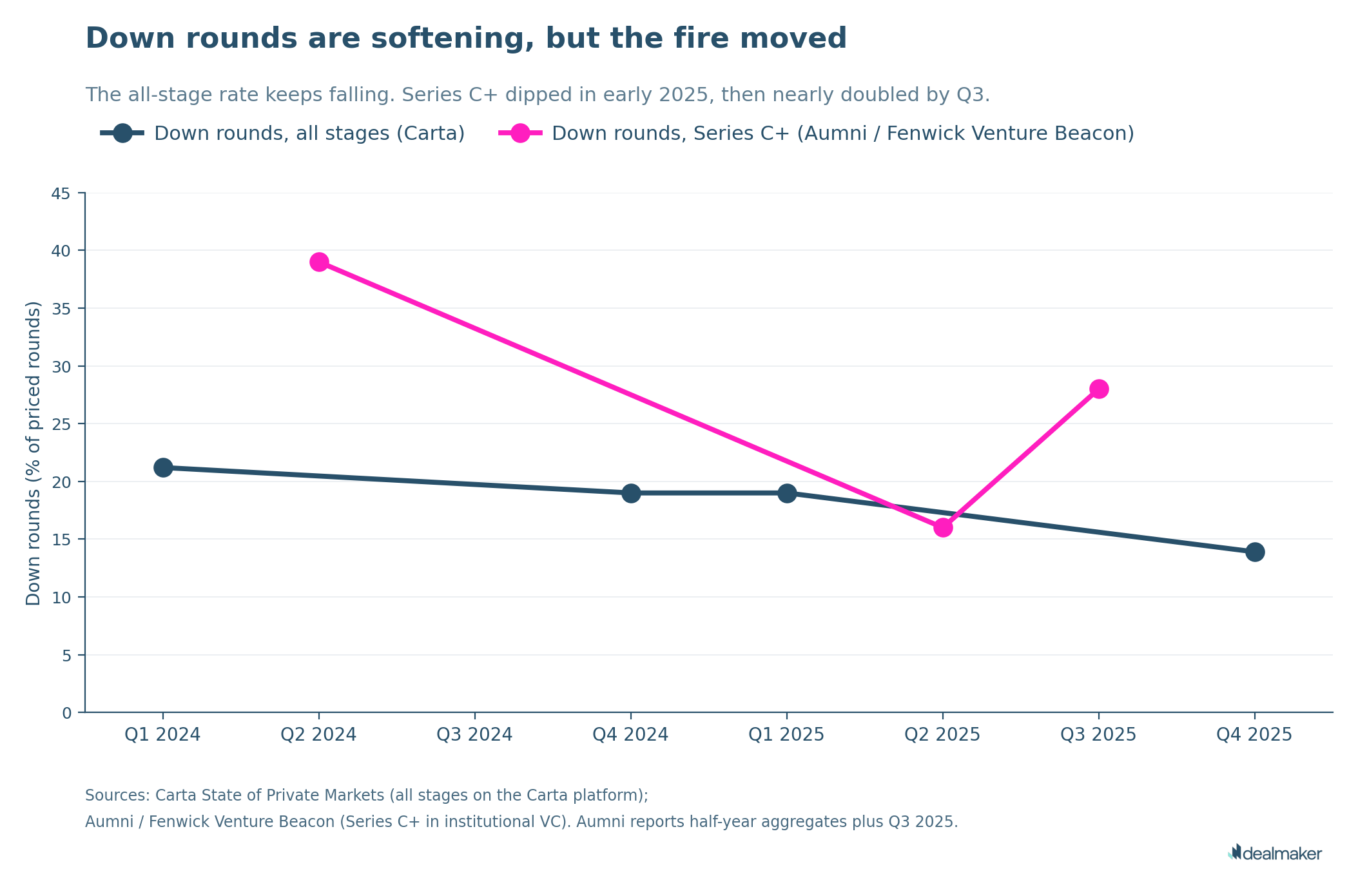
The AI valuation premium at Series A ran roughly +38%, the time between Series A and Series B nearly doubled (1.5 years in 2019 to 2.1 years in 2025), and bridge rounds at late stage hit twice their historical average. If you're not in-category for AI, you're not getting priced like a 2021 deal, you're being asked to do more on less, with worse terms, against an exit market that may not be there when you arrive.
Even the optimistic 2026 scenario hurts you. PitchBook's read: if SpaceX, OpenAI, or Anthropic file (each potentially the largest IPO in history), they could "absorb available underwriting capacity and institutional allocation," pushing the broader IPO return into 2027 (PitchBook-NVCA).
Your liquidity timeline is the riskiest number on your plan, and you probably haven't stress-tested it. Building for "IPO optionality" is not a liquidity strategy. It's a hope, and hope has performed badly as an asset class for the last 36 months.
If you stress-test the assumption, your operating model changes in concrete ways. You start tracking leading indicators alongside ARR: secondary market pricing for comparable companies, IPO throughput in your category, down-round prevalence at your stage. Watch them like you watch revenue. You add liquidity mechanisms to the strategic-options column on your board deck, not as a backup plan but as a live option you've sized and costed. And you start the work now, while you still have leverage. The companies that will look good in three years are the ones that began this in 2026. The ones that start in 2027 will be doing it from a worse seat.
Liquidity has to be engineered. Engineering takes time.
If the exit isn't reliable, the next obvious question is whether the next round is.
It isn't.
The data on where venture capital actually went in Q1 is more brutal than most Series A/B founders realize.
→ Read Part 2: Venture capital is flowing, but not to everybody.

Aaron Shafton is a Registered Representative of DealMaker Securities LLC ("DMS"). The views and opinions expressed in this article are solely his own and do not represent the views, positions, or opinions of DMS or any of its affiliates. This article is for informational purposes only and does not constitute investment advice, a solicitation, or an offer to buy or sell any securities. The data and analysis presented reflect publicly available sources as of the date of publication and are subject to change. Nothing in this article should be relied upon as the basis for any investment decision. Readers should consult a qualified financial advisor before making any investment.







.png)